AI Voice Agent Cost per Call Compared to Human Agents
See how the real cost per call is calculated for AI Voice Agents versus human customer service, along with quality and exception handling.
By Η ομάδα της Argonstack, TechIns Group
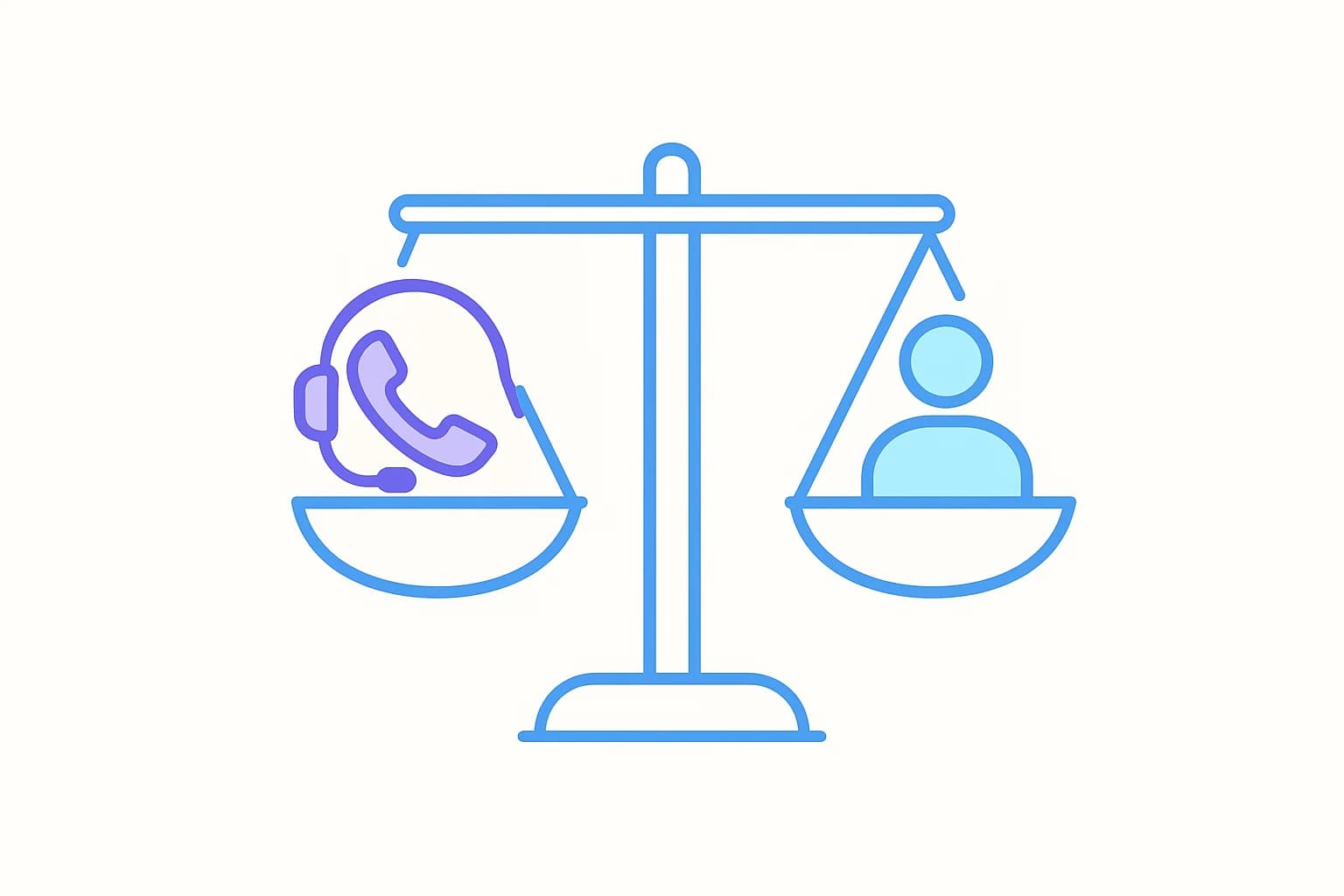
Comparing an AI Voice Agent with human customer service should not be based solely on telephony cost or salary. The real cost per completed call includes wait time, duration, failed attempts, training, supervision, infrastructure, integrations, and the cost of cases that get transferred to a human.
AI can be particularly efficient for repetitive inbound calls, after-hours coverage, collecting basic information, and appointment scheduling. Humans remain stronger at complex negotiation, emotionally charged situations, exceptions, and high-stakes decisions.
How the cost of a human call is calculated
Start from the team's full monthly cost. This includes gross pay, employer contributions, management, training, equipment, software, workspace, and quality control. Then calculate how many calls are actually completed, not how many come in.
If an employee is available for eight hours, they don't handle calls for eight net hours. There are breaks, after-call work, meetings, waiting time, training, and absences. The denominator must be successfully completed calls within the period under review.
Cost per human call equals the total operating cost of the human team, divided by completed calls.
How the cost of an AI call is calculated
AI cost includes the telephony provider, voice minutes, speech recognition, voice synthesis, model usage, platform, integrations, hosting, monitoring, and support. If there is an initial setup cost, it should be amortized over a realistic time horizon.
The cost of calls transferred to a human must also be added. If the agent completes part of the calls autonomously, the overall model includes AI cost for all calls plus human cost for the exceptions.
Cost per AI call equals the total cost of AI operation plus human exceptions, divided by successfully completed calls.
Why cost per minute can be misleading
A cheap call that doesn't achieve its purpose isn't economical. If the caller has to repeat information, calls back, or needs a second human contact, the real cost increases.
The right unit of measurement is often cost per successful outcome. For appointments, that's cost per valid booking. For support, it's cost per case correctly resolved. For lead qualification, it's cost per complete and usable record. The same ROI measurement logic is covered in the article ROI from AI automation.
What factors affect AI cost
Call duration is the first factor. Long, unstructured conversations increase consumption. The second is flow complexity. More integrations and checks require greater setup and maintenance.
The third is the quality of data and APIs. If the calendar or CRM doesn't return reliable data, the agent will need more exception handling. The fourth is language, background noise, and the different ways callers express themselves. The fifth is the required level of quality and monitoring.
When AI Voice makes economic sense
The model becomes stronger when there is steady volume of repetitive calls, significant after-hours demand, or a need for an immediate response. It also has value as overflow when the human line is busy.
It doesn't necessarily make sense when volume is very low, every call is unique, or the human relationship is the core product. In these cases, AI can be limited to collecting initial information and correct routing.
Hybrid model
The most realistic architecture is often hybrid. The AI agent answers immediately, identifies the purpose of the call, collects basic information, completes simple actions, and transfers complex cases with full context.
This way, the human team isn't mechanically replaced. It focuses on the calls where judgment, empathy, and commercial skill create the most value. The transparency and record-keeping rules that must apply in every case are described in the article AI Voice Agent and GDPR in Greece.
The pilot you need before deciding
Choose one specific category of calls and measure volume, duration, wait time, abandonment rate, cost, and successful outcome. Run a pilot with clear boundaries and human handoff. Then compare cost per outcome, quality, complaints, and resolution time.
Argonstack's SIA AI can be used for inbound calls, appointments, request logging, CRM updates, and after-hours coverage. Pricing depends on volume, duration, integrations, and the percentage of cases completed without a human.
Next step
Measure your cost per successful outcome using your own call data.
Frequently asked questions
Is an AI Voice Agent always cheaper?
No. At low volume or with very complex calls, the setup and maintenance may not be justified. The comparison should be made per successful outcome.
Can it work only after hours?
Yes. It can be used for evening calls, weekends, holidays, busy lines, or overflow.
Should it replace the call center?
No. The greatest value often comes when it operates as a first tier and transfers the appropriate cases to a human.
Which KPI should we track?
Cost per successful outcome, autonomous completion rate, transfer-to-human rate, repeat calls, resolution time, and caller satisfaction.