What a proper CRM should include
Not all CRM are the same. Nine key components that separate electronic contact records from integrated operations management systems.

Not all CRM are the same. Others are simply electronic contact files, others are integrated operations management systems. When you consider the option CRM, you need to know what it needs to include to meet really meet the needs of the business. Below is a breakdown of the basics components of a proper CRM today.
1. Centralized customer management
The basis of each CRM is the single client tab. Contact details, chat history, appointments, records and notes must be be gathered in one place.
Without a complete per-customer view, a CRM underperforms as a simple contact list.
2. Single contact inbox
Email, website messages, social media and other channels should be reach a common environment. Otherwise, the team is constantly changing applications and wastes time.
Channel consolidation is not a luxury. It is a functional factor of speed and quality of response.
3. Manage appointments and reminders
A mature CRM includes an online appointment system, synchronization with calendar and automatic reminders to clients and team. No need a separate tool.
Automatic reminders reduce no-shows and keep the team together up to date.
4. Email marketing and campaigns
The ability to create and send email campaigns through CRM unifies the marketing and sales functions. No need for a separate platform.
When campaigns live in the same system as the clientele, segmentation and measurement become truly actionable.
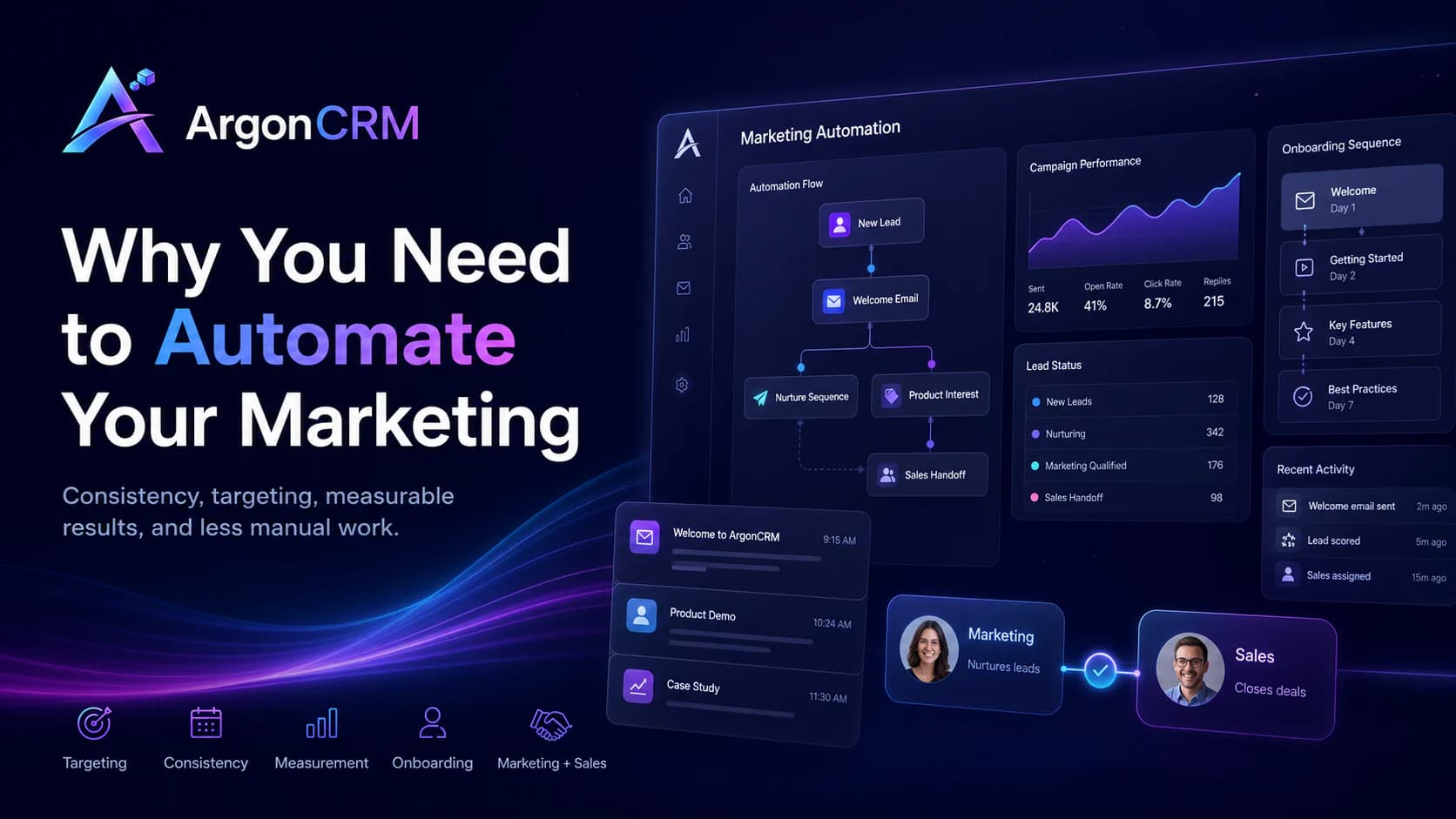
5. Automation and workflows
Visual builder for communication scenarios and internal actions. Follow-ups, sequences, reminders and notifications should be able to be designed and run without technical knowledge.
The automations are the ones that convert CRM from a file to a functional system.
6. AI Assistant
A modern CRM includes a digital assistant that answers common questions, collects data and can make appointments. It acts as a first level of service without replacing human contact.
AI Assistant to Argonstack CRM is trained on the content of the operation and supports the team 24 hours a day.
7. Reports and analytics
A correct CRM gives basic and advanced references for communication, campaigns, sales and customer activity. The goal is visibility of operation, without data overload.
The reports should show what the manager needs, and not just every possible detail.
8. Interfaces with external tools
Google, Meta, WhatsApp, Instagram, Gmail, Outlook, Shopify. A CRM should work with the tools that the business already uses, so that does not require a change in daily processes.
When data flows between tools, the team doesn't waste time in manual information transfers.
9. Simple use and customization
A CRM that is not used is not worth regardless of its capabilities its potential. The user experience should be simple and customizable the needs of each business realistically.
Ease of everyday use determines whether CRM will actually become part of the operation or will remain unused.
Conclusion
A proper CRM is not a contact list with extra functions. It is a single system that covers customer list, communication, appointments, marketing, sales, AI and reporting.
When you select CRM, the question is not whether it has features, but whether the features work together as a system and are adopted by by the group in everyday life.
See how Argonstack CRM consolidates all of the above into into a single operating environment.