What to write in a marketing email to my customers
Many businesses send generic messages that are not readable. Seven practical rules for writing emails that really deliver.

Writing a marketing email is one of the places where more opportunities are missed than it seems. Many businesses send generic emails that don't get read. Below is a breakdown of what you really need to write in a marketing email to perform and represent your business properly.
1. Start with the reader
The first question is not what you want to say, but what will benefit the recipient. Emails that start with what is relevant to the reader have significantly better results.
When the reader finds value, they are willing to listen to the sentence that you have. Value first, sale second.
2. In the subject
The subject is the most important part of the email. It determines whether it will be read or left in the inbox. It should be short, clear and communicate the core value.
Subjects of 5 to 8 words that clearly say what the reader will find inside usually perform better than clever or poetic formulations.
3. In the first lines
The first sentence must confirm the promise of the subject and keep the interest. No wishful thinking or introductions that fill space without substance.
The reader gives a few seconds. The words wasted in an introduction are words that were not read.
4. In the main part
Short paragraphs, clear flow, one main message. The reader should be able to read easily from one sentence to the next without getting confused.
Email without structure is not readable. Spaces, short paragraphs and bold points help with reading.
5. In the call to action
Every marketing email should have a clear call to action. What exactly do you want the reader to do after reading it. Without a CTA, the email doesn't produce a result.
Many different buttons and action suggestions reduce the performance. A clear CTA per email performs better.
6. In personalization
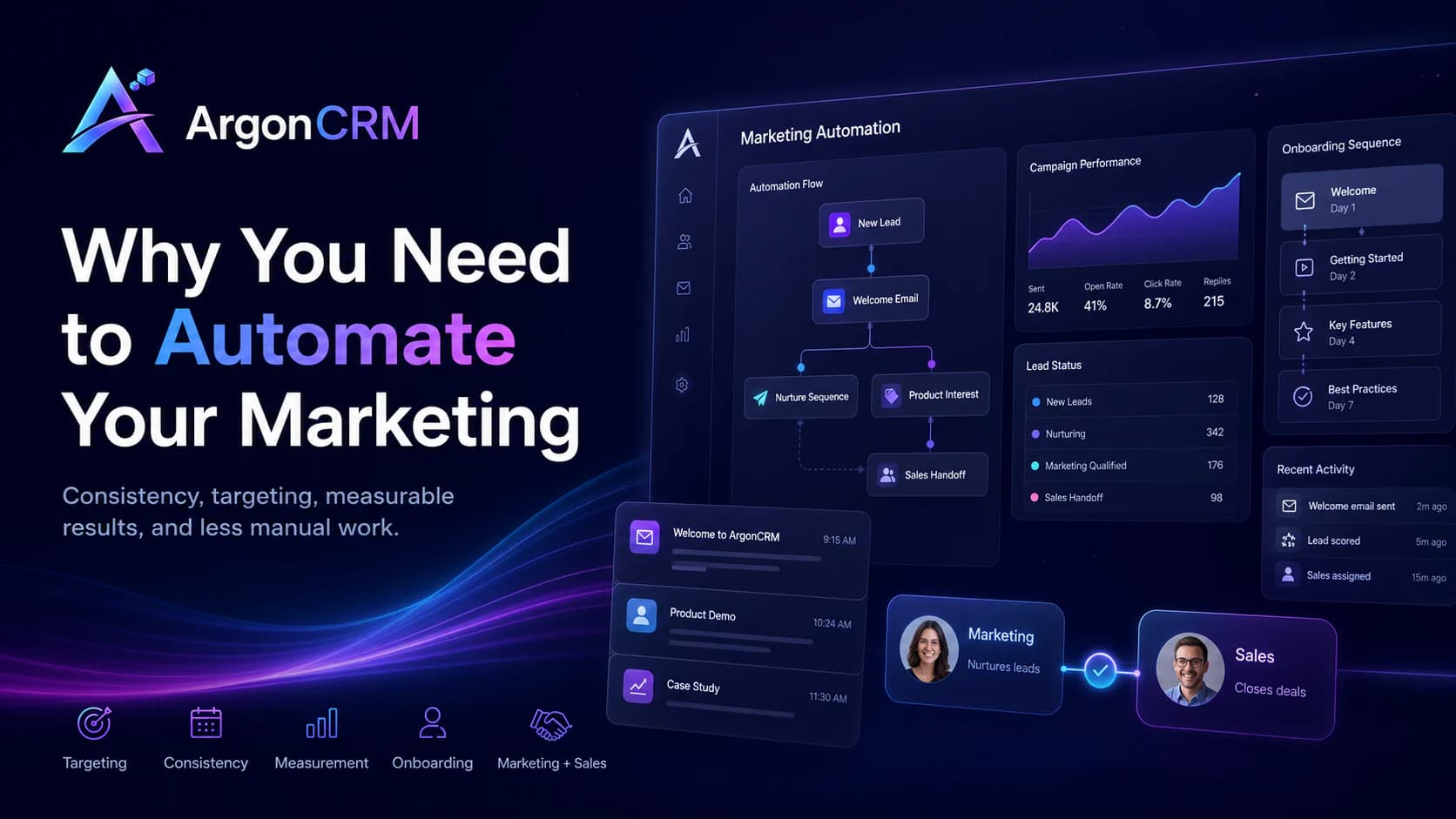
The reference to the recipient's name or previous behaviour gives the message a personal character. With a CRM, personalization is easily done on a large scale.
When the reader sees that the message is specifically about him, the response response is significantly higher.
7. In closing
The closing should be brief, with a clear signature and the correct contact details. No thank you paragraph that loses the momentum of the message.
A consistent footer with contact details and an unsubscribe option is essential for professional presence and compliance.
Conclusion
A good marketing email is short, clear and focused on the reader. Subject that pulls you in, a clear message and a specific call to action.
When the client list is properly organized in a CRM, the writing becomes simpler and the results measurable.
See how Argonstack CRM integrates email composer, segmentation and analytics in a single environment.