How to organise my client list
The proper organization of the customer base is one of the most critical issues of any business. Six practical steps for a central structure, clear stages and automation.

The proper organization of the clientele is one of the most critical issues in any business business. When data is broken in emails, excel and notebooks, time is wasted, customers are lost and errors increase. Below is a breakdown of how to organize your customer list in a way that supports day-to-day operations and business growth.
1. With centralized system
The first and most important step is the transfer of all contacts to a centralized environment. Only then is there a true picture of the customer base, without double entries, forgotten contacts and lost contact history.
A CRM like Argonstack CRM acts as a central source of truth for all contacts, regardless of the channel they came from.
2. In reasonable groups
Categorising customers facilitates communication and targeting. Logical groups can be active customers, leads, old customers, B2B and B2C, or groups by service.
With tags and categories, customers are organized by criteria that have and are used in campaigns, reports, and reports automation.
3. With full history
A full contact history must be recorded for each customer. Emails, messages, appointments and call notes give the full picture and allow anyone in the team to continue the conversation from the from where it left off.
When CRM is synchronized with email and communication channels, the logging is automatic and does not depend on the employee remembering it.
4. With clear stages
Not all customers are at the same stage. Some are young, others are ready to buy, others in a revisit phase. A properly organized customer list separates the stages and allows for corresponding action.
With a visual pipeline you can see where each customer is and what action needed to move to the next stage.
5. With automations
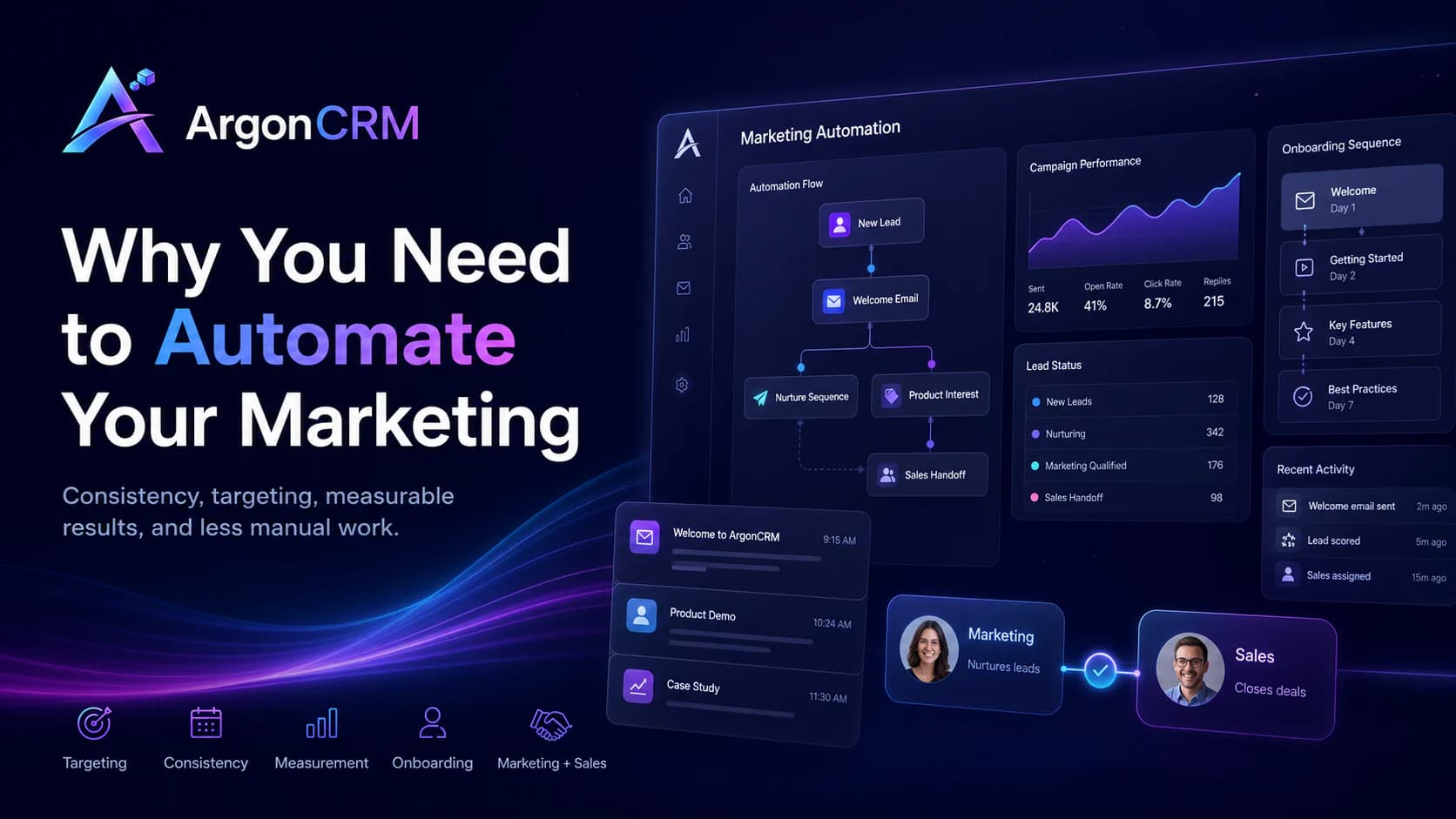
Organising is not a one-time project. It is a continuous process. The automation ensures that new leads are entered correctly, that they are categories are updated and follow-ups are initiated without human intervention.
When the organisation relies on automation, the data remains clear regardless of volume or speed of customer addition.
6. With clear contact property
Each customer must be assigned a responsible person. When it is not clear who handles each contact, customers fall through the cracks or receive conflicting responses.
Defining owner per contact and opportunity ensures that each customer has specific contact person.
Conclusion
Organizing a clientele is not a matter of a nice list, but of a functional system. With a central base, clear categories, a complete history, a clear stages and automation, the business gains real control of customers and opportunities.
See how Argonstack CRM consolidates contacts, history, pipelines and automations in one environment.